


Zombie Strike: Shoot Fire
FIRE GAME
Zombie Strike: Shoot Fire puts me straight into the kind of pressure its premise suggests: the world has collapsed, the threat is immediate, and every encounter is built around surviving the next wave of danger. As an adventure game from FIRE GAME, it aims for quick action rather than a slow, story-heavy journey. I found the appeal easy to understand after the first few minutes: deal with the enemies in front of me, collect the result, improve my position, and then decide whether I am ready to try again.
That simple structure is also the most important thing to understand before downloading it. This is not the right choice if you want a quiet exploration game, a long dialogue-driven campaign, or a carefully simulated survival experience. It is better suited to players who enjoy short bursts of zombie combat and the satisfying feeling of turning a difficult attempt into a slightly better one. The game is free to start, carries a Mature 17+ rating, and includes optional purchases ranging from $0.99 to $49.99 per item, so I would approach it as an action game with a progression loop rather than as a completely frictionless free experience.
How the first action sets the tone
The first action matters because Zombie Strike: Shoot Fire does not need much explanation to communicate its purpose. I enter a dangerous situation, focus on the immediate undead threat, and try to keep control while the pressure builds. The attraction is not a complicated opening tutorial or an elaborate introduction. It is the directness of the encounter: something is moving toward me, I need to respond, and the quality of that response determines how comfortably I reach the next moment.
That direct start makes the game approachable for anyone familiar with mobile zombie shooters. I do not have to learn a huge collection of systems before understanding what I am supposed to do. The basic mental process is clear: identify danger, act quickly, avoid wasting opportunities, and stay alive long enough to claim the outcome. For a game designed around an apocalypse scenario, that immediacy feels appropriate.
At the same time, the opening can feel less satisfying to players who need a strong narrative hook. The store summary frames the player as humanity’s last line of defense, but the practical appeal comes from the combat loop rather than from a richly explained world. I would recommend it to someone who wants to pick up an Android or iOS game and begin fighting almost immediately. I would point a story-first player toward a more narrative-focused adventure instead.
Related News






The useful tension between speed and control
What I like about the first stage of a session is the tension between acting quickly and acting carefully. Rushing every response may feel exciting, but it can also make a run harder to manage. Taking a moment to read what is happening gives me a better chance of making the next action count. That creates a small but meaningful decision inside what might otherwise be a straightforward shooter: do I push forward aggressively, or do I protect the run I have already built?
This is one of the game’s more useful lessons for new players. I would not treat every encounter as a race to clear the screen. A safer approach is to establish a rhythm first, learn how much pressure I can handle, and only then start taking bigger risks. That habit becomes particularly valuable when a run has already produced a worthwhile reward. Losing a promising attempt because of impatience is more frustrating than losing a weak one.
The game’s Mature 17+ rating is also worth considering before installation. Zombie-themed action is not automatically suitable for every player, especially younger users or anyone who dislikes intense undead violence. Parents choosing a game for a family device should treat the age label as a real filter rather than assuming that a cartoon-like mobile presentation makes the content appropriate for children.
Gallery
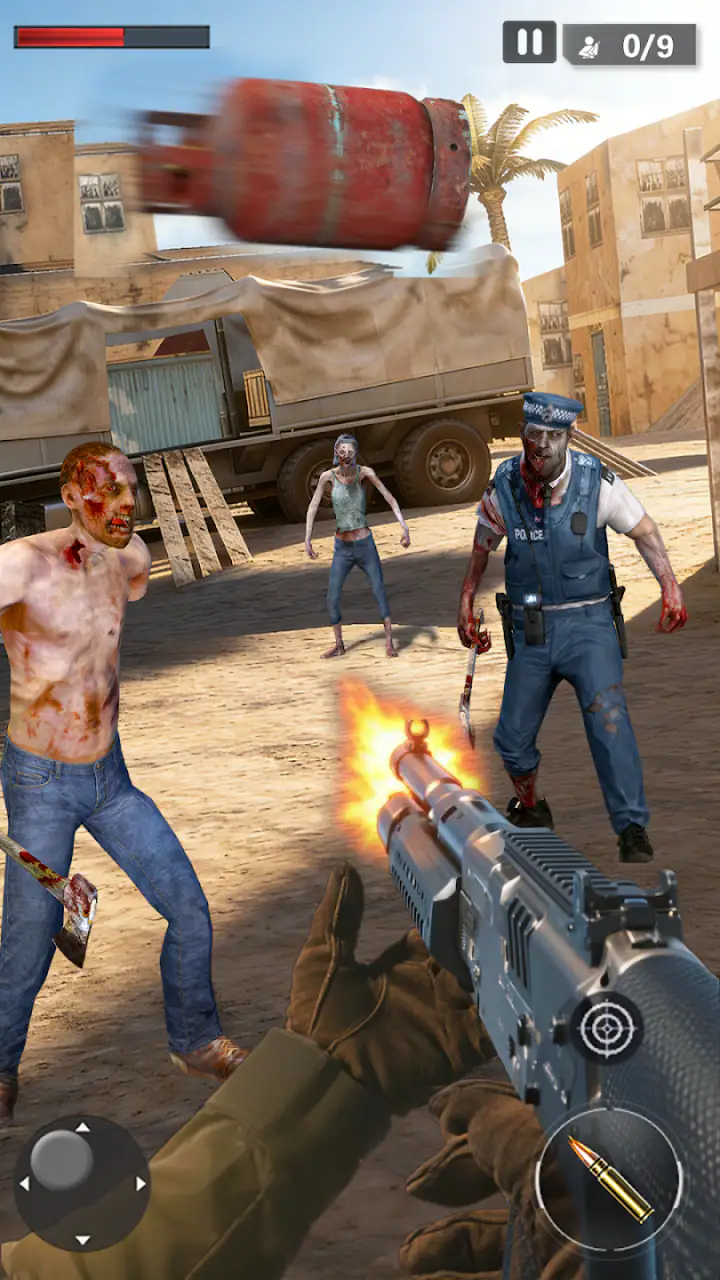
The feedback rhythm that keeps another attempt tempting
Zombie Strike: Shoot Fire works best when the feedback arrives in a steady sequence. I take an action, see its immediate consequence, survive a little longer, and receive a reason to continue. That rhythm is what separates a playable action loop from a series of disconnected fights. Even when a session is brief, the game gives me a clear sense that what I just did mattered.
The strongest part of this rhythm is the relationship between danger and response. A zombie is not merely background decoration; it creates a problem that needs an answer. Once I deal with that problem, the temporary relief becomes its own reward. Then the next threat restores the pressure. The cycle is easy to follow, which makes the game suitable for short breaks when I want something more active than a puzzle but less demanding than a long console-style adventure.
My advice is to pay attention to the moment after a successful exchange, not just the attack itself. That is where I can judge whether I am genuinely controlling the session or simply surviving by luck. If I am repeatedly taking damage or losing control immediately after a successful action, the problem may be poor timing rather than insufficient progression. Recognizing that distinction helps me decide whether to change my play or spend resources on improvement.
Why the action can feel better in short sessions
The game’s loop is naturally suited to compact play. I can begin with a clear objective, work through a dangerous sequence, and stop after a meaningful result instead of needing a large uninterrupted block of time. That makes it a practical choice for a commute, a waiting room, or a short evening break when I want a focused burst of zombie action.
There is a trade-off, though. The same repetition that makes the game easy to return to can become tiring if I expect every session to introduce a radically different idea. Players who enjoy mastering a familiar pattern may find the repetition comfortable. Players who need constant novelty may feel that the action settles into a predictable routine. I would judge the game by how much satisfaction I get from improving execution, not by expecting it to reinvent the adventure genre every time I play.
A useful everyday scenario is a five-minute break between tasks. I can start a run, concentrate on the immediate threat, finish with a reward, and put the phone away without feeling that I abandoned a complicated storyline halfway through. In contrast, I would be less likely to choose it for a long social gaming session where I want deep cooperation, extensive exploration, or a shared world. Its strength is focused individual momentum.
Rewards, progression, and the cost of chasing improvement
The reward stage is what gives the action a purpose beyond simply clearing another group of zombies. After a successful attempt, I have a reason to look at what I earned and consider how it affects the next run. That creates a practical question: should I use the result to make the next session safer, or should I hold on to it and aim for a bigger improvement later?
I prefer games that make this decision feel meaningful, and Zombie Strike: Shoot Fire benefits from keeping the reward connected to the next attempt. The best use of a reward is not always the most immediately powerful option. If I am struggling because I make mistakes under pressure, a small improvement that helps me survive longer may be more valuable than an upgrade chosen only because it looks impressive. In other words, I would spend with the next failure point in mind.
This is also where the free-to-play structure deserves attention. The game costs nothing to download, but optional in-app purchases are available, with individual items priced from $0.99 up to $49.99. I would recommend deciding on a personal spending limit before getting deeply invested in progression. That simple step keeps the reward loop enjoyable instead of allowing a difficult session to turn into an impulse purchase.
How I would manage the reward loop
My preferred approach is to wait until I can identify a repeated problem before spending anything. If I fail because the action becomes too difficult to control, an improvement may be useful. If I fail because I take unnecessary risks, buying progress will not solve the underlying issue. This distinction is easy to overlook because a purchase can feel like an immediate answer, but better decision-making often produces a more satisfying improvement.
I would also avoid judging the entire game by one unsuccessful run. A failed attempt still teaches me where the session breaks down: at the opening, during sustained pressure, or near the point where I become overconfident. Once I know that, the next run has a purpose. The reward is not only the item or progress I receive; it is also the information that helps me adjust my play.
Players who dislike any form of optional spending should think carefully about whether the progression model will irritate them. The game is free, but the presence of purchases means the experience is not designed around a completely purchase-free environment. For someone comfortable ignoring optional offers, that may be manageable. For someone who wants every advancement to come only through play, a premium adventure game may be a better fit.
What the session reset adds to the design
A good reset gives failure a useful shape. When a run ends, I am not simply returned to the beginning with nothing learned. I can think about what caused the collapse, what reward I secured, and what I should change before starting again. That makes the next session feel like a test of improved judgment rather than an identical replay.
The reset is especially important in a zombie game because the fantasy depends on sustained pressure. If every attempt were effortless, the apocalypse would feel harmless. If every attempt were brutally punishing, returning would feel pointless. The appeal lies between those extremes: enough danger to make survival satisfying, but enough continuity to make another try feel worthwhile.
One of my practical rules is to reset mentally before resetting mechanically. After a difficult attempt, I would take a moment to identify one specific adjustment instead of changing everything at once. Maybe I need to react earlier, conserve my attention, or stop chasing an attractive reward when the situation is already unstable. A single clear change makes the next test easier to evaluate.
When the reset becomes a weakness
The reset can lose its appeal if I feel that progress depends more on repetition or spending than on better play. That is the main friction I would watch for during longer sessions. A loop can be satisfying when each attempt reveals something, but it becomes less engaging when I am repeating the same sequence without a clear strategic lesson.
For that reason, I would play in controlled blocks rather than grinding indefinitely. A few focused attempts are more useful than continuing after my attention has dropped. Zombie action depends on reaction and awareness, and tired play makes every failure feel more arbitrary. Stopping at the right time protects the strongest part of the design: the feeling that the next session begins with a genuine chance to do better.
This also answers an important practical question: is the game suitable for long uninterrupted play? It can be, if I enjoy repeating action and refining my responses, but I do not think that is where its value is clearest. Its most comfortable role is a repeatable short-session adventure that I can return to when I want immediate pressure and a visible result.
Who should play it and who should choose another adventure
I think Zombie Strike: Shoot Fire is a good match for players who enjoy mobile zombie combat, quick decisions, and progression that gives each attempt a reason to continue. It is particularly appealing if I want a game that starts quickly, keeps the objective understandable, and does not require me to memorize a complicated story before the action becomes enjoyable.
The game has also found a substantial audience, with over 500 thousand installs and a 4.6 average from around 8 thousand ratings. Those figures suggest that the straightforward formula connects with many players, although popularity does not remove the personal trade-offs. The experience still depends on whether I enjoy repetition, accept the Mature 17+ presentation, and feel comfortable with optional purchases.
I would skip it if my priority is peaceful exploration, deep character role-playing, competitive multiplayer, or a carefully authored cinematic campaign. I would also be cautious if I am easily frustrated by repeated attempts or if I prefer games with no monetization pressure at all. A slower survival adventure may be better for someone who wants to manage resources and explore a world at their own pace, while a narrative zombie game may suit someone who cares more about characters than rapid combat.
On the technical side, the current version is 1.2.0 and the game requires Android 8.0 or later. That makes checking the operating system a sensible step before downloading, especially on an older phone or tablet. I would also leave enough storage and battery for a comfortable session, not because the game promises a particular technical profile, but because action games are simply less enjoyable when the device is already struggling.
My verdict on the action-reward-reset loop
After looking at the complete cycle, I see Zombie Strike: Shoot Fire as a focused adventure game built around momentum. The first action gives me an immediate problem, the feedback rhythm tells me whether I am handling it, the reward gives the next attempt a purpose, and the reset turns failure into a reason to adjust rather than quit. That is a coherent design, even if it will not satisfy players looking for broad exploration or a large narrative experience.
The most important tip I can offer is to treat each session as a small experiment. Start by learning the pressure, watch where control slips, use rewards to address a real weakness, and then return with one deliberate change. That approach reveals more of the game’s value than simply rushing through attempts or spending whenever progress slows.
FIRE GAME has made a free zombie shooter for an audience that wants direct action and a repeatable challenge. I would recommend it to a friend who likes short, tense mobile sessions and is comfortable making progress gradually. I would not recommend it to someone seeking a relaxed adventure or a purchase-free experience. The loop is strongest when improvement comes from better decisions, not just from pushing the next button.
In my experience, that is the reason another session begins: not merely because zombies are waiting, but because the previous attempt leaves me with a clear question about what I can do better. If that question sounds more exciting than exhausting, Zombie Strike: Shoot Fire is worth trying.
FAQs for Zombie Strike: Shoot Fire
What is Zombie Strike: Shoot Fire?
Zombie Strike: Shoot Fire is an action shooting game focused on surviving waves of zombies and improving your combat abilities. You typically control a heavily armed character, aim at incoming enemies, collect rewards, and unlock stronger equipment as you progress. The gameplay is designed for short sessions, making it suitable for players who enjoy straightforward zombie battles without a complicated story or lengthy tutorials.
Is Zombie Strike: Shoot Fire free to download and play?
The game is generally available as a free download, allowing you to start playing without an upfront purchase. However, free-to-play games commonly include optional in-app purchases for weapons, upgrades, resources, or other bonuses. Progress can usually be made without spending money, although upgrading equipment and advancing more quickly may be easier for players who choose to purchase additional items.
Does Zombie Strike: Shoot Fire require an internet connection?
Whether all features work offline can depend on the version installed and the device being used. Core shooting stages may be accessible without a constant connection, but advertisements, rewards, cloud saving, updates, and certain events may require internet access. For the most reliable experience, connect to Wi-Fi before downloading updates and check the game’s current store description for offline limitations.
Is Zombie Strike: Shoot Fire suitable for children?
Zombie Strike: Shoot Fire contains cartoon-style violence, firearms, explosions, and repeated attacks against zombies, so it may not be appropriate for very young children. The exact age recommendation can vary between the Android and iOS stores. Parents should also review the game’s advertising, in-app purchase options, and privacy information before allowing children to play without supervision.
What devices are compatible with Zombie Strike: Shoot Fire?
Compatibility depends on the operating system, device model, available storage, and the minimum version required by the developer. Before downloading, check the official Google Play or App Store listing to confirm that your phone or tablet is supported. Keeping the operating system updated and having enough free storage can help prevent installation problems, crashes, or slow performance during intense zombie waves.
Pros
- Fast-paced shooting keeps short play sessions engaging.
- Simple controls make aiming and movement easy to learn.
- Wide zombie variety adds challenge as you progress.
- Weapon upgrades provide a clear sense of progression.
- Offline play is useful when you have no internet access.
Cons
- Repetitive missions may reduce long-term variety.
- Energy or stamina limits can interrupt extended sessions.
- Some upgrades may require significant grinding.
- Ads can affect the flow between levels.
- Device performance may drop during crowded zombie waves.


